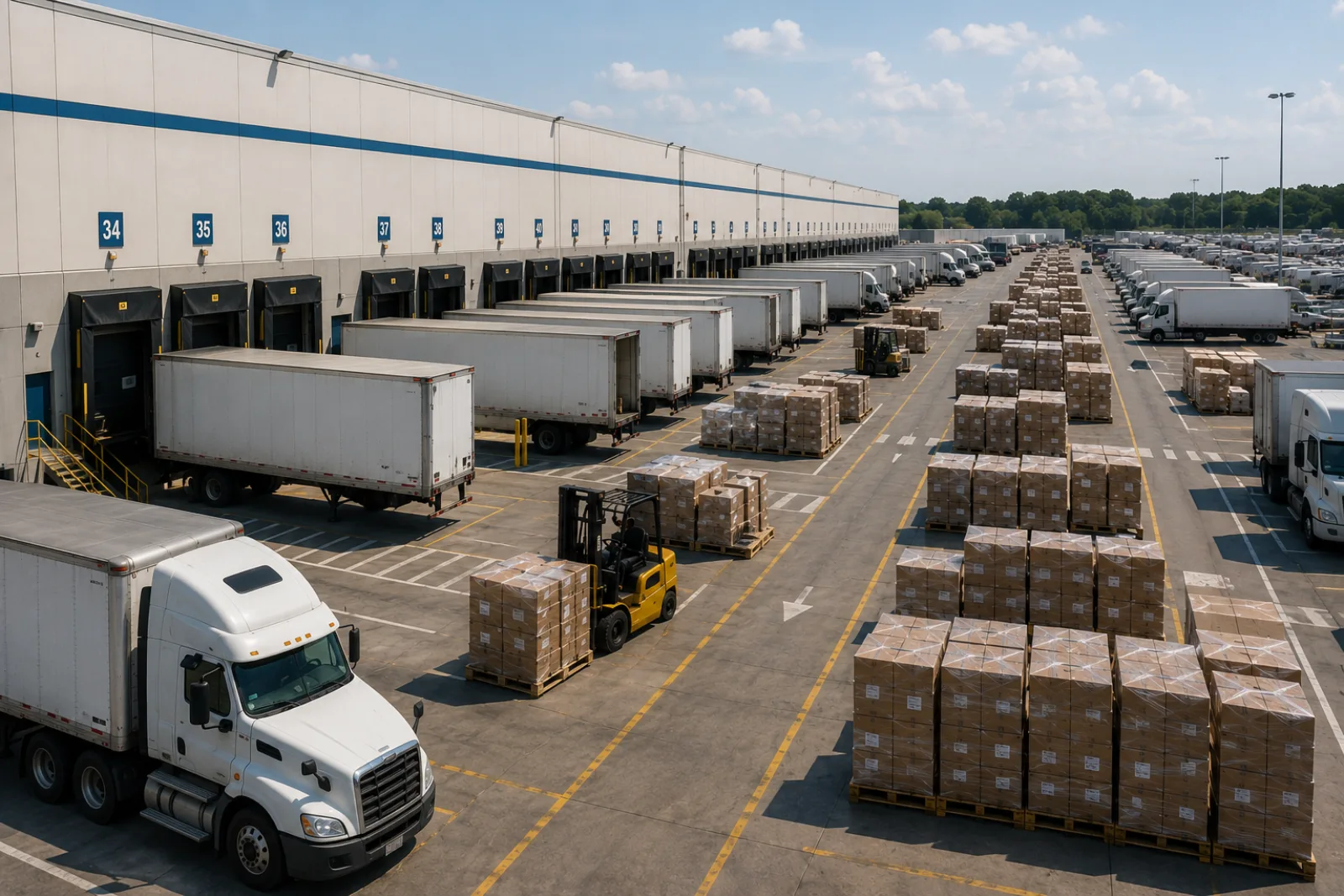
Seasonal Retailer Deploys a Custom-Built WMS Across 60 3PL Facilities
A purpose-built SaaS WMS for a seasonal retail operation running across a 60-site third-party logistics network, built for configurability and warehouse execution control at a fraction of the cost of enterprise alternatives.
Processed over 4.6 million inbound and 4.6 million outbound cartons during peak seasonal cycles
Supported weekly peak volumes exceeding 850,000 cartons across 60 3PL distribution centers
Improved end-to-end visibility across all 60 distribution centers, without the overhead of a traditional enterprise WMS
Engagement snapshot
The challenge
The customer operates a highly dynamic, seasonal retail supply chain supported by 60 distributed 3PL warehouse partners across North America. Warehouse operations relied on fragmented data exchanges, limited real-time visibility into carton and pallet movements, and manual coordination across systems. As seasonal demand peaks approached, the existing setup lacked the scalability and resilience required for high-volume inbound and outbound operations, resulting in fulfillment delays, data inconsistencies, and limited ability to scale efficiently.
The customer evaluated traditional enterprise WMS platforms and custom-built solutions from other services organizations but found that their seasonal, high-velocity 3PL model required a purpose-built approach from a company with deep supply chain experience. Off-the-shelf systems could not deliver the required unique operations, configurability, rapid deployment timeline, or cost efficiency at the scale of a 60-facility operation.
What Everest delivered
Everest designed and implemented a fully custom Warehouse Management System (WMS) delivered as a SaaS solution, purpose-built to match the exact operational workflows, seasonal rhythms, and business rules of the client's 60-site 3PL network. The project followed a structured, iterative delivery model with multiple build cycles, 500+ test cases, and phased releases aligned to peak seasonal demand.
Unlike traditional enterprise WMS implementations, which carry a heavy configuration effort alongside significant licensing and professional services costs, Everest's custom SaaS approach put a production-ready system in place for the peak season it was built for. The result: a WMS built precisely the way this business actually runs, not adapted from a generic platform, at a fraction of the cost of comparable enterprise alternatives.
Solution components
- Distributed warehouse management system supporting large-scale 3PL operations across 60 facilities, purpose-configured to match the client's exact business processes
- Handheld RF-based carton and pallet tracking with real-time data capture in warehouse environments
- Centralized web-based dashboards for monitoring, reconciliation, invoicing, and operational visibility
- Bi-directional data synchronization framework with delta-based reconciliation between edge devices and backend systems
- High-volume inbound and outbound supply chain execution with pallet-level tracking and location-based inventory through a Put Away module
- Exception-driven processing for operational mistakes and data inconsistencies
- SQL-based relational database, SFTP data ingestion pipelines, and API-driven backend services
Approach
The project followed a structured, iterative delivery model aligned with seasonal retail timelines. Multiple build cycles were deployed across web and handheld platforms, supported by extensive QA validation including 500+ test cases and regression cycles.
The system was validated across high-volume transaction scenarios, offline-to-online synchronization cases, and exception handling workflows to ensure stability and accuracy. Continuous testing and phased releases enabled smooth production deployment ahead of peak seasonal demand, with minimal post-release defects and high system reliability.
Why custom-built WMS delivered greater value
This engagement demonstrates a compelling case for purpose-built software in complex supply chain environments. When a seasonal retailer's operational model does not align with the assumptions baked into enterprise WMS platforms, the cost of forcing that fit, in effort, money, and ongoing customization, often exceeds the cost of building the right tool from scratch.
Delivered as a SaaS offering, Everest's WMS removes the upfront capital expenditure associated with traditional on-premise implementations while providing enterprise-grade performance, security, and support. The client received a system that runs exactly the way their business runs, not the other way around.
Quantified impact
Impact & outcomes
- Processed over 4.6 million inbound and 4.6 million outbound cartons during peak seasonal cycles
- Supported weekly peak volumes exceeding 850,000 cartons across 60 3PL distribution centers
- Improved end-to-end visibility across all 60 distribution centers, without the overhead of a traditional enterprise WMS
- Streamlined pallet and carton tracking with reduced manual reconciliation
- Efficient handling of exception scenarios (mis-sorts, blind receipts, unlabeled cartons)
- Reduced dependency on manual coordination and email-based communication
- Real-time and offline-capable data synchronization ensuring consistent data availability across all 60 facilities, regardless of connectivity conditions
Post go-live impact
Post go-live, the platform demonstrated strong scalability and stability under peak seasonal demand across all 60 3PL distribution centers. Real-time dashboards and reporting capabilities improved operational visibility for both warehouse users and corporate teams, enabling faster decision-making and issue resolution.
The system reduced dependency on manual coordination and email-based communication, improved user efficiency in warehouse workflows, and ensured consistent data availability through real-time and offline synchronization capabilities.
Tools & platforms
- SQL-based relational database supporting high-volume transactions (150K+ record handling capability)
- Real-time and offline-capable data synchronization layer with delta-based reconciliation
- SFTP-based data ingestion pipelines for external data sources (Kit Ship Advice, Outbound BOL, IBBOL, CBBOL, Inbound BOL, Store Backfill feeds)
- API-driven backend services for transaction processing and data synchronization
- Handheld RF scanning devices for warehouse data capture
- Web-based dashboards and reporting systems
Frequently asked questions
Quick answers about this engagement, drawn from the case content above.
The customer operates a highly dynamic, seasonal retail supply chain supported by 60 distributed 3PL warehouse partners across North America. Warehouse operations relied on fragmented data exchanges, limited real-time visibility into carton and pallet movements, and manual coordination across systems. As seasonal demand peaks approached, the existing setup lacked the scalability and resilience required for high-volume inbound and outbound operations, resulting in fulfillment delays, data inconsistencies, and limited ability to scale efficiently.
Everest designed and implemented a fully custom Warehouse Management System (WMS) delivered as a SaaS solution, purpose-built to match the exact operational workflows, seasonal rhythms, and business rules of the client's 60-site 3PL network. The project followed a structured, iterative delivery model with multiple build cycles, 500+ test cases, and phased releases aligned to peak seasonal demand. Unlike traditional enterprise WMS implementations, which carry a heavy configuration effort alongside significant licensing and professional services costs, Everest's custom SaaS approach put a production-ready system in place for the peak season it was built for. The result: a WMS built precisely the way this business actually runs, not adapted from a generic platform, at a fraction of the cost of comparable enterprise alternatives.
Processed over 4.6 million inbound and 4.6 million outbound cartons during peak seasonal cycles. Supported weekly peak volumes exceeding 850,000 cartons across 60 3PL distribution centers. Improved end-to-end visibility across all 60 distribution centers, without the overhead of a traditional enterprise WMS. Streamlined pallet and carton tracking with reduced manual reconciliation. Efficient handling of exception scenarios (mis-sorts, blind receipts, unlabeled cartons). Reduced dependency on manual coordination and email-based communication.
Key tools and platforms included SQL-based relational database supporting high-volume transactions (150K+ record handling capability); Real-time and offline-capable data synchronization layer with delta-based reconciliation; SFTP-based data ingestion pipelines for external data sources (Kit Ship Advice, Outbound BOL, IBBOL, CBBOL, Inbound BOL, Store Backfill feeds); API-driven backend services for transaction processing and data synchronization; Handheld RF scanning devices for warehouse data capture; Web-based dashboards and reporting systems.
This case study comes from the Retail industry, delivered through Everest Technologies' Supply Chain practice.
 Supply Chain
U.S. Specialty Apparel Retailer Accelerates Omnichannel Upgrade Across Three Brands with Manhattan Active®
 Supply Chain
ATOM, Automated Trailer Order Management Enables Scalable, Real-Time Trailer Planning and Execution
 Supply Chain
3PL Warehouse Execution Platform Enables Offline-First, Scalable Operations Across Distributed Warehouse Network
Have a similar challenge?
Talk to our practice leads about how a comparable engagement could work for your team.