Integration, Data, & Analytics
Governed data flow
ready for analytics and AI
Everest engineers reliable pipelines, reusable logic, observability, and platform foundations so data becomes trustworthy enough to power analytics, automation, and AI.
From fragmented data to governed flow
Take data from scattered and noisy to trusted and production-ready

Fragmented sources
Expose where source systems break trust before analytics even begins
Disconnected operational systems, delayed extracts, and brittle integrations create reporting that teams do not fully trust.

Governed movement
Create reliable ingestion and transformation patterns
Pipelines become more useful when data movement, transformation logic, and quality controls are observable instead of hidden in manual workarounds.

Production-ready access
Serve analytics and AI from cleaner semantic foundations
Data platforms are more valuable when reporting, decision support, and machine learning all rely on the same governed structure.
Pipeline journey
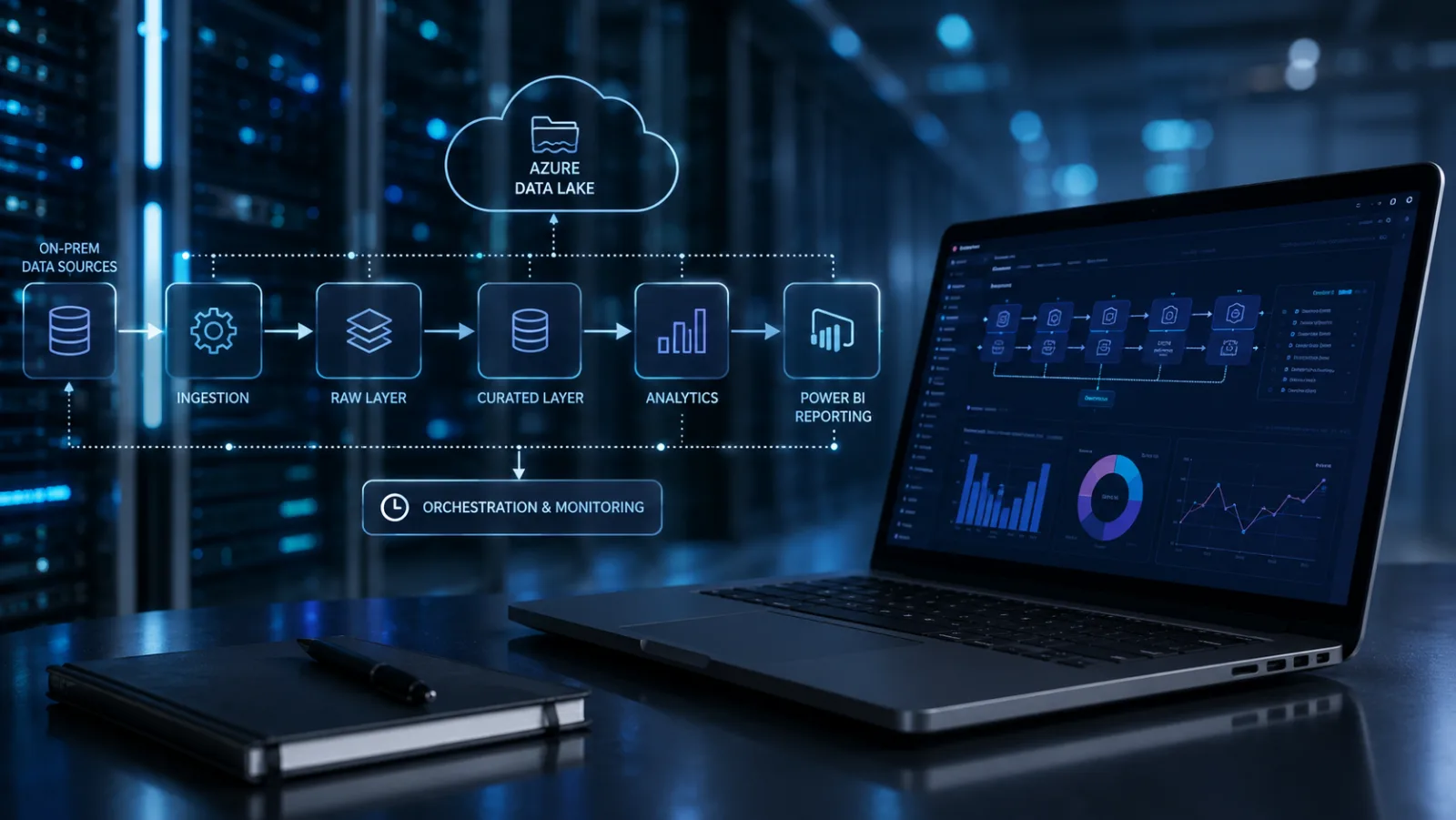
Move through the data platform step by step
The downstream experience only improves when every stage of the pipeline is engineered with reliability, governance, and reuse in mind.
Source systems
Start with the operational systems that actually drive the business
The pipeline begins by treating transactional platforms, documents, and external feeds as products that need reliable access patterns.
Ingestion
Make ingestion observable instead of brittle
Reliable ingestion reduces dependency on ad hoc exports and creates cleaner movement into the platform.
Transformation
Shape data into governed, reusable models
Transformation is where semantics, business rules, and quality controls become durable enough for teams to reuse.
Storage
Build storage that supports both analytics and expansion
Storage design has to support scale, access control, performance, and future AI use cases, not just current reporting.
Semantic access
Give teams one trusted access layer
Data products, shared metrics, and semantic layers reduce confusion and keep downstream consumption aligned.
Analytics + AI
Let analytics and AI consume a foundation they can trust
Analytics, automation, and AI accelerate when they sit on top of governed data movement and clearer semantic logic.
Proven outcomes, measured results
Enterprise engagements with quantified business impact. Open a case for the full story, or browse every case at once.
 Integration, Data & Analytics
Fortune 500 Apparel Retailer Stabilizes Cloud Data Warehouse Batch Processing and Achieves SLA Alignment
 Integration, Data & Analytics
Enabling Scalable and Efficient System Integrations Through Boomi to Workato Migration
What our clients say
Frequently asked questions
Scope is driven by the number and complexity of source systems and by the state of the data in them, since data quality work is usually the largest variable. We do not wait for a big bang rollout: pipelines, models and dashboards are released in phases, with use cases delivered in parallel to the foundational platform so the business sees working outputs while the platform is still being built out.
We start by mapping all critical data sources, POS, e-commerce, ERP, supply chain, etc., and defining how they should connect. Data pipelines (ETL/ELT) are then built to consolidate and standardize this data into a central platform. We prioritize high-value data first rather than trying to integrate everything at once. This approach delivers faster results with less disruption.
We implement validation rules, data quality checks, and governance layers within the pipelines. A single source of truth is defined, so all reporting pulls from the same standardized datasets. We also track lineage, so you know where data is coming from and how it is transformed. Accuracy improves significantly when both pipelines and definitions are aligned.
A warehouse is structured and optimized for reporting, while a data lake stores raw, unstructured data. A lakehouse combines both, allowing flexibility with performance. Most modern architectures use a lakehouse approach (e.g., Databricks) or cloud warehouse (e.g., Snowflake) depending on needs. The choice depends on your data types, scale, and analytics requirements, not just trends.
We design pipelines based on business needs, not everything requires real-time processing. For use cases like order tracking or inventory updates, we implement streaming or near real-time pipelines. For reporting and analytics, batch processing is often sufficient and more cost-effective. The architecture is usually a mix of both.
Yes, but some level of data readiness is required. We often start by preparing specific datasets for targeted AI use cases rather than overhauling everything. This includes cleaning, structuring, and validating relevant data. Over time, the broader data platform can evolve to support more advanced AI capabilities.
We implement curated data models and self-service BI tools with clear definitions and governance. Instead of exposing raw data, we provide business-friendly dashboards and datasets. Training and documentation are also part of the rollout. The goal is to enable access without creating confusion.
We define role-based access controls, data ownership, and usage policies upfront. Sensitive data is restricted, masked, or encrypted as needed. Governance frameworks ensure consistency across teams while maintaining compliance. This becomes especially important as data usage scales across the organization.
Most clients see faster query performance, reduced report generation time, and better system reliability. It is common to see 30-50% improvements in reporting speed. More importantly, teams spend less time preparing data and more time using it. That is where the real value comes from.
We design for scalability from the start, using cloud-native platforms that handle increasing data volumes and workloads. Pipelines are optimized for performance and cost. We also monitor usage patterns and adjust architecture as needed. The goal is to avoid rework as your data grows.
Ready to build your data foundation?
Let us help you move from fragmented data to governed, production-ready pipelines that power analytics and AI.