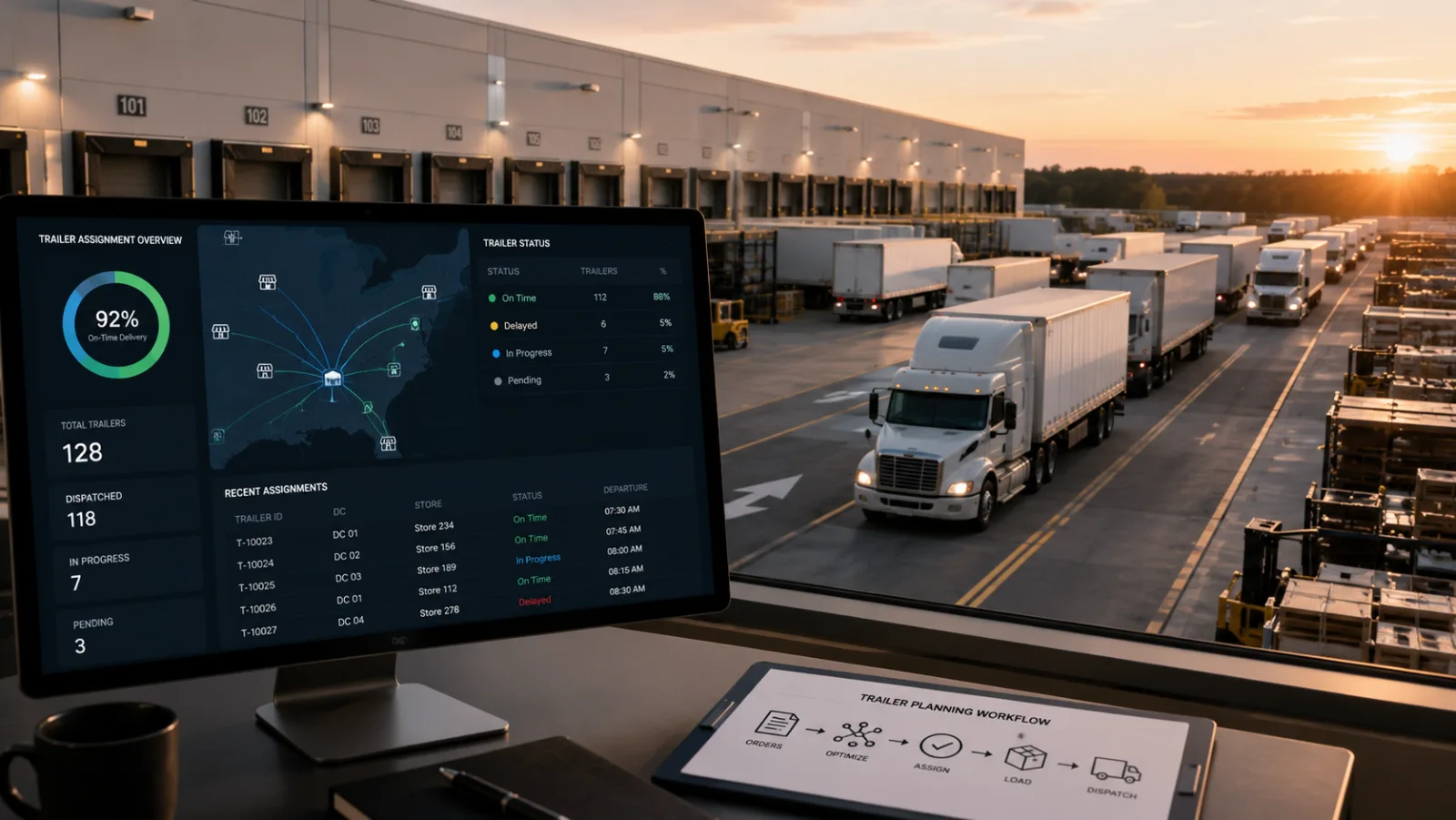
ATOM, Automated Trailer Order Management Enables Scalable, Real-Time Trailer Planning and Execution
Automated trailer build ensures the right furniture is on every truck for on-time customer delivery.
Ensured the right furniture is on every trailer, enabling on-time delivery to customers and freeing store associates to focus on serving customers
Increased asynchronous processing capacity from 10 to 50 concurrent threads
Enabled near real-time automated assignment cycles at 5-minute intervals
Engagement snapshot
The challenge
Prior to Everest's involvement with a well-known furniture retailer relied on a legacy IBM i/AS400-based system for trailer planning that required extensive manual decision-making from both DC operations teams and store associates. Orders were prioritized and assigned through a combination of static rules and significant human judgment, pulling store teams away from serving customers and into the logistics process. The result was fragmented workflows, limited visibility into future trailer loads, and a persistent risk of the wrong merchandise arriving at stores which causes missed customer delivery commitments.
The absence of a centralized orchestration layer led to lack of real-time synchronization between systems. Operational teams had to manually manage prioritization, capacity constraints, and last-minute changes. As order volumes increased, these limitations caused sub-optimal trailer utilization, higher dock intervention, delays in execution, and increased operational overhead.
Additionally, there was limited real-time visibility into order-to-trailer mapping, poor synchronization between systems, and no automated prioritization mechanisms. As order volumes grew, these constraints compounded, causing sub-optimal trailer utilization, delayed customer deliveries, and an over-reliance on human decision-making that scaled poorly and introduced unnecessary risk.
What Everest delivered
ATOM began as Everest Technologies' own thought leadership initiative. The Everest team conceived, designed, and built the platform independently, then demonstrated its capabilities to our customer's leadership, who recognized its potential and engaged Everest to implement it as their production solution. ATOM was architected as a native extension of Manhattan Active® Omni (MAO), allowing the legacy IBM i/AS400-based system to be fully retired and replaced with a modern, cloud-native orchestration layer between order management and warehouse execution. The platform automates the trailer build process end-to-end, ensuring the right merchandise is loaded on every truck dispatched from the DC to stores, so customers receive their furniture on time, every time, without store associates having to manage the process manually.
Solution components
- Automated trailer order management platform (ATOM)
- Enabled automated order-to-trailer assignment across a distributed retail network
- Reduced manual planning effort and improved utilization
- Rule-based optimization engine
- Integrated with Manhattan Active® Omni (OMS)
- Supported routing, capacity, and prioritization logic
- Centralized orchestration layer
- Enabled real-time ingestion of order data
- Provided bi-directional synchronization between OMS and execution systems
- Core platform capabilities
- Dynamic load sequencing and capacity optimization
- Day capping engine based on cube and stop thresholds
- Exception handling with manual override (Priority 0 mode)
- Centralized dashboards, reporting, and audit tracking
- Microservices-based architecture
- Decomposed monolithic system into services including Auto Assignment, Day Capping, WebApp, and Reporting
- Enabled scalable, high-volume processing
- Legacy system integration
- Integrated with IBM i / AS400 through middleware
- Ensured reliable data synchronization across systems
Approach
The project followed a phased product engineering approach, beginning with targeted store deployments to validate functionality, performance, and operational impact before expanding across the full store network.
Development was executed iteratively, with continuous refinement of assignment logic, prioritization rules, and system integrations based on operational feedback. Performance and scalability were improved by increasing asynchronous processing capacity and enabling concurrent workloads.
Continuous testing and validation ensured stability under near real-time processing conditions, while close collaboration with business and operations teams ensured alignment with supply chain workflows.
Impact & outcomes
- Ensured the right furniture is on every trailer, enabling on-time delivery to customers and freeing store associates to focus on serving customers
- Increased asynchronous processing capacity from 10 to 50 concurrent threads
- Enabled near real-time automated assignment cycles at 5-minute intervals
- Supported multiple order types (Customer, Extras, Samples, Add-ons)
- Transitioned from monolithic to microservices-based architecture for scalability
- Improved trailer capacity utilization through rule-based optimization
- Reduced dependency on manual dock-level intervention
- Enhanced operational visibility through centralized dashboards and reporting
Post go-live impact
Post go-live, the platform demonstrated strong stability and performance under real-world operational conditions, supporting near real-time trailer assignment across the store network without disruption.
The platform achieved high adoption among operational users due to automated assignment capabilities, dashboards, and manual override features. Performance improvements enabled efficient handling of concurrent workloads during peak execution cycles.
Operational teams benefited from improved visibility into order-to-trailer mapping, better planning accuracy, and dramatically reduced manual coordination. Store associates were freed from the burden of trailer planning decisions, giving them more time to focus on serving customers and delivering an improved in-store experience. The successful retirement of the legacy IBM i/AS400 system marked a significant modernization milestone for the customer's supply chain operations.
Tools & platforms
- Manhattan Active® Omni (OMS)
- Google Cloud Platform (GCP)
- Boomi AtomSphere
- NGINX
- Spring Boot (microservices)
- Angular
- React Native
- IBM i / AS400
- Firestore / distributed data stores
- GitLab pipelines, systemd deployment
- Logback logging, system monitoring
Client perspective
ATOM has significantly streamlined our trailer planning and execution by replacing manual coordination with an automated, system-driven approach. The platform's ability to integrate seamlessly with our existing systems and provide real-time visibility has improved our operational efficiency and planning accuracy.
Frequently asked questions
Quick answers about this engagement, drawn from the case content above.
Prior to Everest's involvement with a well-known furniture retailer relied on a legacy IBM i/AS400-based system for trailer planning that required extensive manual decision-making from both DC operations teams and store associates. Orders were prioritized and assigned through a combination of static rules and significant human judgment, pulling store teams away from serving customers and into the logistics process. The result was fragmented workflows, limited visibility into future trailer loads, and a persistent risk of the wrong merchandise arriving at stores which causes missed customer delivery commitments.
ATOM began as Everest Technologies' own thought leadership initiative. The Everest team conceived, designed, and built the platform independently, then demonstrated its capabilities to our customer's leadership, who recognized its potential and engaged Everest to implement it as their production solution. ATOM was architected as a native extension of Manhattan Active® Omni (MAO), allowing the legacy IBM i/AS400-based system to be fully retired and replaced with a modern, cloud-native orchestration layer between order management and warehouse execution. The platform automates the trailer build process end-to-end, ensuring the right merchandise is loaded on every truck dispatched from the DC to stores, so customers receive their furniture on time, every time, without store associates having to manage the process manually.
Ensured the right furniture is on every trailer, enabling on-time delivery to customers and freeing store associates to focus on serving customers. Increased asynchronous processing capacity from 10 to 50 concurrent threads. Enabled near real-time automated assignment cycles at 5-minute intervals. Supported multiple order types (Customer, Extras, Samples, Add-ons). Transitioned from monolithic to microservices-based architecture for scalability. Improved trailer capacity utilization through rule-based optimization.
Key tools and platforms included Manhattan Active® Omni (OMS); Google Cloud Platform (GCP); Boomi AtomSphere; NGINX; Spring Boot (microservices); Angular; React Native; IBM i / AS400; Firestore / distributed data stores; GitLab pipelines, systemd deployment.
This case study comes from the Retail industry, delivered through Everest Technologies' Supply Chain practice.
 Supply Chain
3PL Warehouse Execution Platform Enables Offline-First, Scalable Operations Across Distributed Warehouse Network
 Supply Chain
Improving Inventory Accuracy and Operational Continuity in High-Volume Warehouse Operations
 Supply Chain
Supporting Warehouse Modernization and Returns Automation Across Distribution Operations
Have a similar challenge?
Talk to our practice leads about how a comparable engagement could work for your team.